How to write an informative speech
An informative speech teaches. You are not arguing for anything. The audience should leave knowing three things they did not know, and be able to repeat them.
Seven parts, about five minutes, 600 to 700 words. Most of the work is choosing what to leave out.
00:01The structure
7 sections, in this order.
-
01
Opening
Why is this worth five minutes of their attention?
Why should they care for five minutes? Connect the topic to something they already do, own or wonder about.
-
02
Point
What are the three things they will know when you sit down?
Tell them the three things they will know when you sit down. Listeners cannot skip ahead the way readers can, so a preview helps them follow.
-
03
Point
What is the first thing, and which example makes it clear?
The first thing, with one example. Begin with whatever the other two depend on.
-
04
Proof
Which fact or number will surprise them, and where is it from?
A fact or number that will surprise them, with the source said aloud. Put it here, in the middle, when attention dips.
-
05
Point
What is the second thing, and how does it follow from the first?
The second thing, and how it follows from the first. Say the link out loud: “Because of that…”.
-
06
Point
What is the third thing — the part most people get wrong?
The third thing. Save the part most people get wrong for last. It is what they will repeat at lunch.
-
07
Closing
How do you say all three once more, in one breath?
Say all three once more in a single sentence. Then stop. No new information in the ending.
00:02The rules
The rules of the room.
Structure carries the speech; these keep it out of trouble.
- Five minutes, or the assignment's limit.
- Three points is what a listener can hold. If you have a fourth, it replaces one of the three.
- Explain. Do not argue. If you catch yourself saying “should”, you have moved into a persuasive speech.
- Define any word your classmates would not use.
- One example for each point.
00:03Questions
Asked before every informative speech.
- What is an informative speech?
- A speech that explains a topic without taking a side. The aim is that the audience understands and remembers it.
- What is the structure of an informative speech?
- An opening that gives a reason to listen, a preview of the main points, the points in a logical order with an example each, and a summary.
- How long should an informative speech be?
- Usually four to six minutes in class, about 500 to 800 words.
- What is the difference between an informative and a persuasive speech?
- An informative speech explains how something is. A persuasive speech argues for what should change. The first ends with a summary, the second with a call to action.
00:04In the app
From outline to on time.
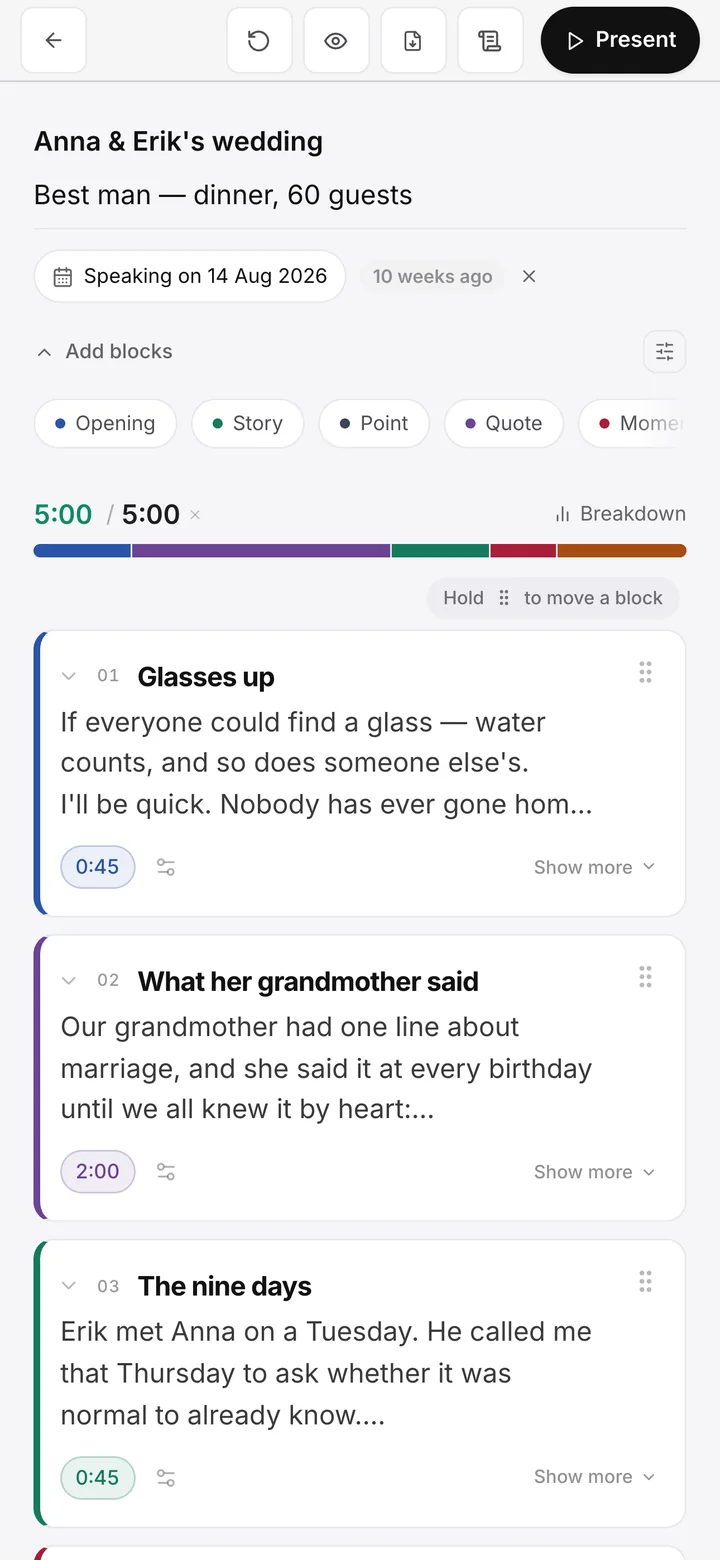
Every section gets a time, and the total tells you whether you will fit your slot. You write your lines directly inside each block, so the words and the shape never drift apart.
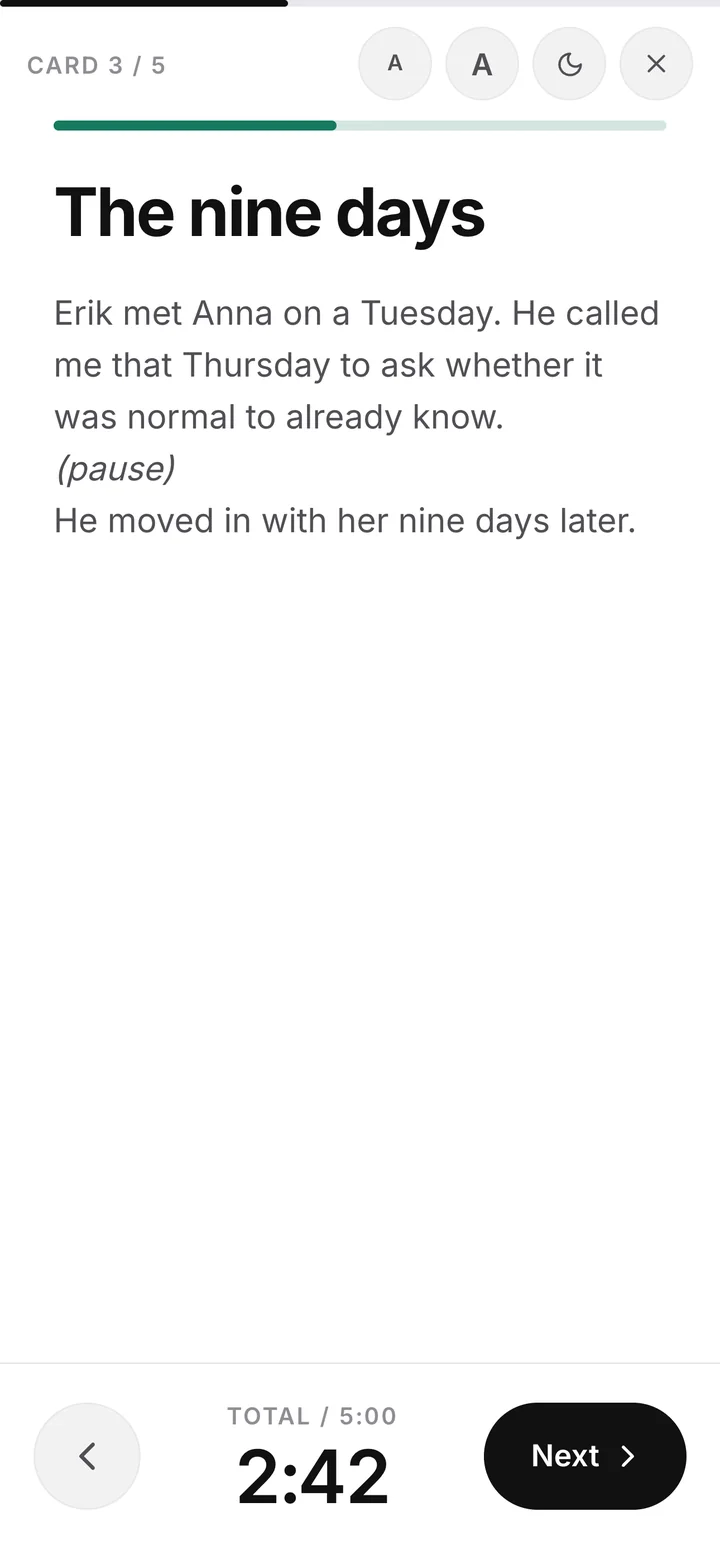
When it is time to deliver, the same outline becomes full-screen cue cards with a stage clock, or a teleprompter that follows the pace you planned.
Open this outline now Download on the App Store How long will it run? Use the speech time calculator → Thinking of letting AI write it? Read this first →
00:05Related
Other shapes for the same room.
A problem, your fix, the proof and one thing to do — 5–6 min
Who you are, one promise you can keep, and the ask — under 2 min
From one of the class, to the class — the years, the thanks, what comes next — 5 min
From the invited speaker or a teacher — look back, one lesson, send them forward
Introduce yourself to the club — 4 to 6 min
Answer on your feet in two minutes: point, reason, example, point
 SpeechDraft
Open this outline in SpeechDraft.
The informative speech template, one of 64 in the app. Writing is free and never limited.
Free to start. Pro is $9.99, once.