How to write an elevator pitch
An elevator pitch is a 30 to 60 second answer to “what do you do?” that ends with a clear request. It is not a summary of your career or your company. It is one problem, one proof and one ask.
Four parts of about fifteen seconds each, 130 to 150 words in all. If it runs longer it is a presentation, and nobody agreed to one.
00:01The structure
4 sections, in this order.
-
01
Opening
Who are you, in one line a stranger could repeat?
Your name and what you are, in words the listener already uses. “I'm Sara, I run a bakery that delivers to offices” beats a job title. If they could not repeat it to someone else, shorten it.
-
02
Point
What problem do you solve, and for whom?
The problem and who has it. Be specific about the person: “office managers who order lunch for forty people every Friday”. A named customer makes the problem real.
-
03
Proof
What is the one result that proves it?
One result with a number in it. “Twelve offices reorder every week”, or “we cut the wait from an hour to ten minutes”. One figure is remembered. Three are not.
-
04
Closing
What are you asking this person for, exactly?
Ask for one thing this person can actually give: an introduction, twenty minutes next week, a look at the deck. End on the ask and stop talking.
00:02The rules
The rules of the room.
Structure carries the speech; these keep it out of trouble.
- Thirty to sixty seconds. About 75 words for the short version, 150 for a full minute.
- No jargon the listener would not use themselves.
- One number, not five.
- Keep two versions: one for people in your field, one for everyone else.
- Say it aloud twenty times. A pitch that still sounds written is not ready.
00:03Questions
Asked before every elevator pitch.
- How long should an elevator pitch be?
- 30 to 60 seconds. At a normal speaking pace that is 75 to 150 words.
- What should an elevator pitch include?
- Four things: who you are, the problem you solve and for whom, one piece of proof, and a specific ask.
- How do I write an elevator pitch for a job interview or a networking event?
- Use the same four parts with yourself as the subject: what you do now, the kind of problem you are good at, one result you are proud of, and what you are looking for next.
- What is the difference between an elevator pitch and a sales pitch?
- An elevator pitch opens a conversation in under a minute and asks for a next step. A sales pitch is the longer conversation that follows, with detail, pricing and objections.
00:04In the app
From outline to on time.
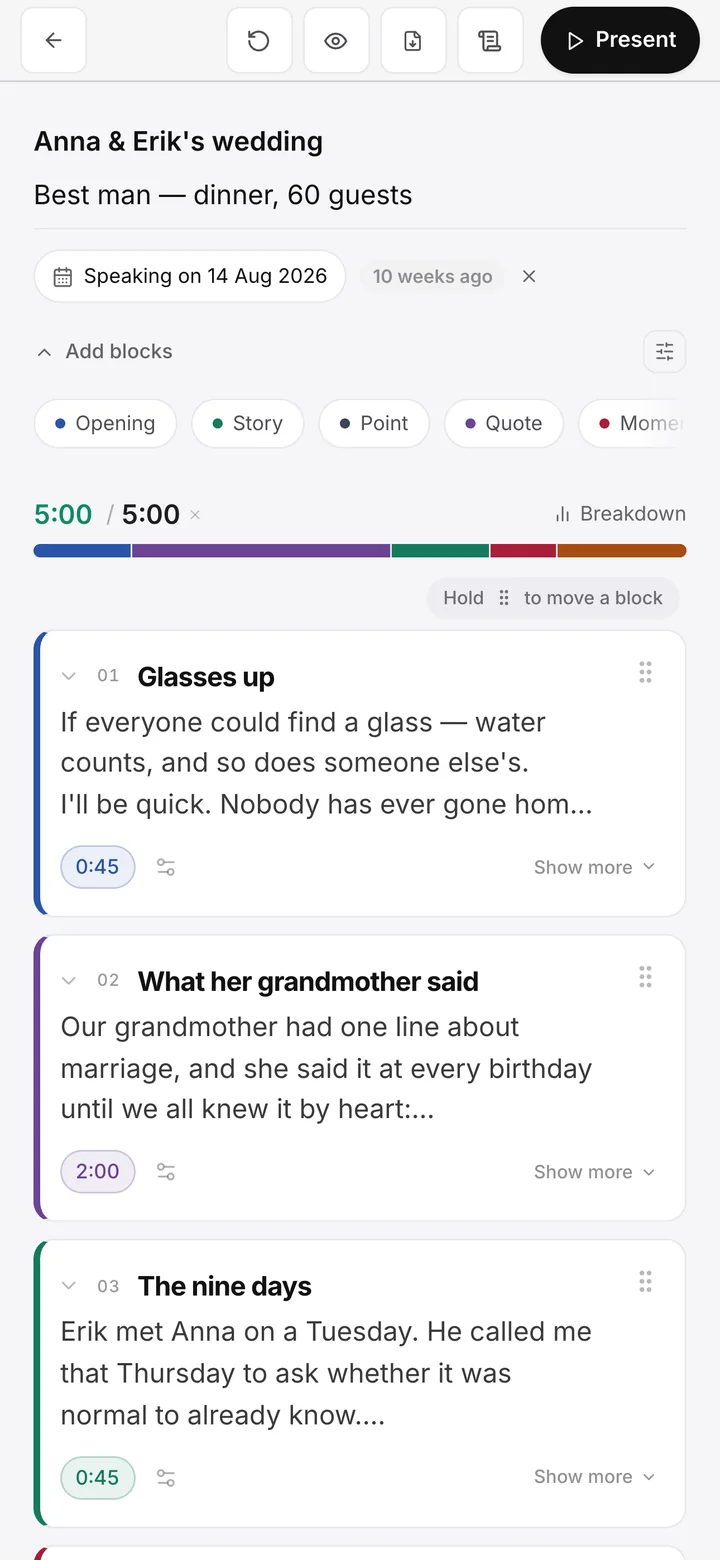
Every section gets a time, and the total tells you whether you will fit your slot. You write your lines directly inside each block, so the words and the shape never drift apart.
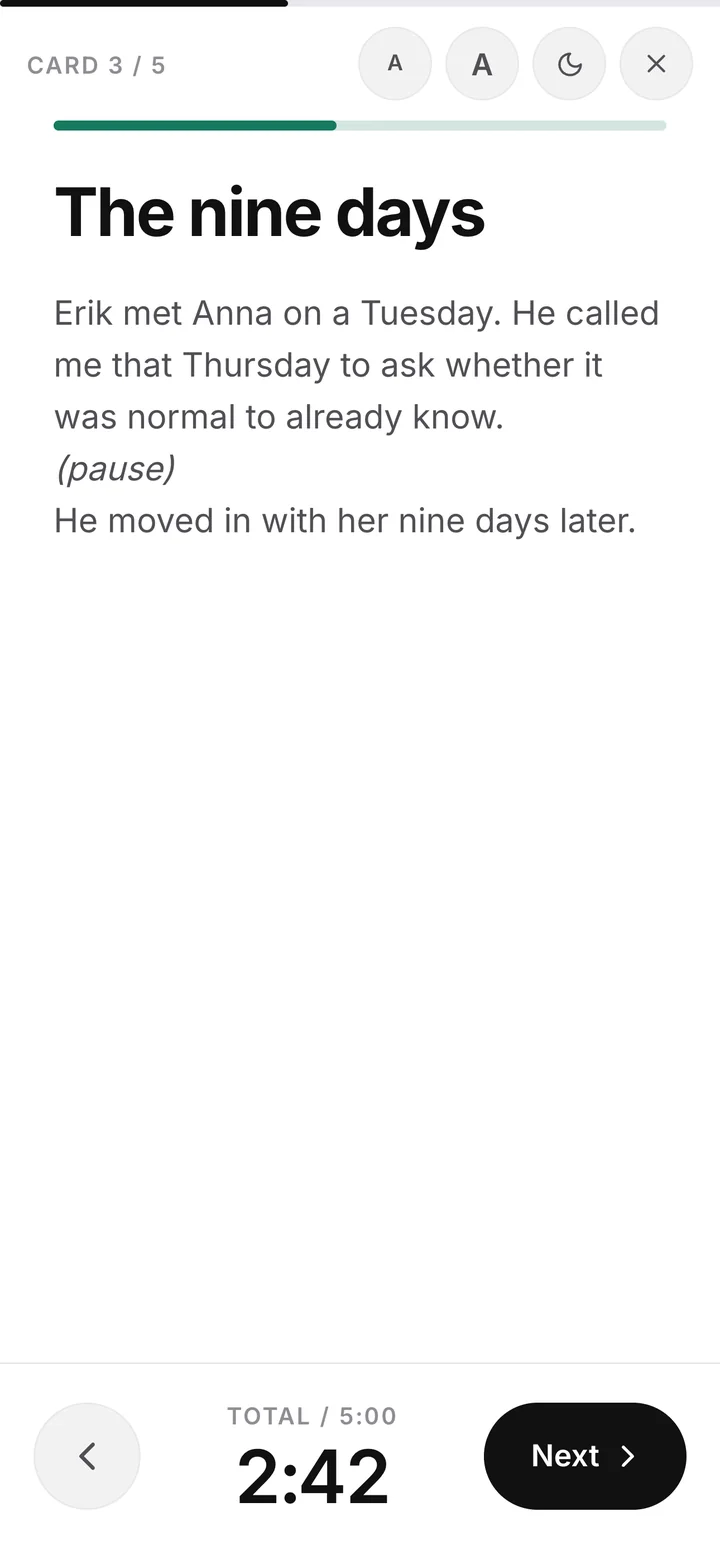
When it is time to deliver, the same outline becomes full-screen cue cards with a stage clock, or a teleprompter that follows the pace you planned.
Open this outline now Download on the App Store How long will it run? Use the speech time calculator → Thinking of letting AI write it? Read this first →
00:05Related
Other shapes for the same room.
The 90-second answer — one human line, your pitch early, then the proof and what you want to do here
The ten-minute task for a panel, then their questions — their problem, your plan, proof you have done it
To a new team, class or room — your name, one thing to remember you by — 1 min
Introduce yourself to the club — 4 to 6 min
Answer on your feet in two minutes: point, reason, example, point
Warm, personal and ending with the toast — 3–5 min
 SpeechDraft
Open this outline in SpeechDraft.
The elevator pitch template, one of 64 in the app. Writing is free and never limited.
Free to start. Pro is $9.99, once.