How to introduce yourself
First day in a new job, first lesson in a new class, your turn in the circle at a meeting. You have about a minute, and people will remember one thing from it. Decide which thing.
Four parts, 45 to 60 seconds, 100 to 150 words. Your name, what you do, one detail, and what people can come to you for.
00:01The structure
4 sections, in this order.
-
01
Opening
What is your name, and what should they call you?
Your name, said slowly, and what you would like to be called. If people often get it wrong, give them a way to remember it.
-
02
Point
What do you do, said the way you would say it to a neighbor?
What you do, said the way you would say it to a neighbor. “I make sure the invoices go out on time” is better than a job title.
-
03
Story
Which one detail will they remember you by tomorrow?
One detail they will remember tomorrow. You keep bees, you have moved eleven times, you have run the same route every morning since 2015. It gives people something to ask you about.
-
04
Closing
What can they come to you for, and what do you hope to get from them?
What they can come to you for, and one thing you hope to get from them. It turns an introduction into the start of a conversation.
00:02The rules
The rules of the room.
Structure carries the speech; these keep it out of trouble.
- One minute. In a round of introductions, thirty seconds.
- Say your name twice, once at the start and once at the end.
- One detail. A list of hobbies is forgotten by the next person's turn.
- Leave out your career history. It will come up.
- Practice it aloud once. Most people rush their own name.
00:03Questions
Asked before every introduce yourself.
- How do I introduce myself in a new job?
- Give your name, what you will be doing in plain words, one personal detail, and what colleagues can come to you for. Keep it under a minute.
- How long should a self-introduction be?
- 45 to 60 seconds, about 100 to 150 words. Half that if everyone in the room is taking a turn.
- How do I introduce myself in class?
- The same four parts work: your name, what you study or where you are from, one thing people can remember you by, and something you hope to get out of the class.
- What is a good fun fact about yourself?
- Something true and specific that invites a question. “I have moved eleven times” works. “I like traveling” does not, because most people do.
00:04In the app
From outline to on time.
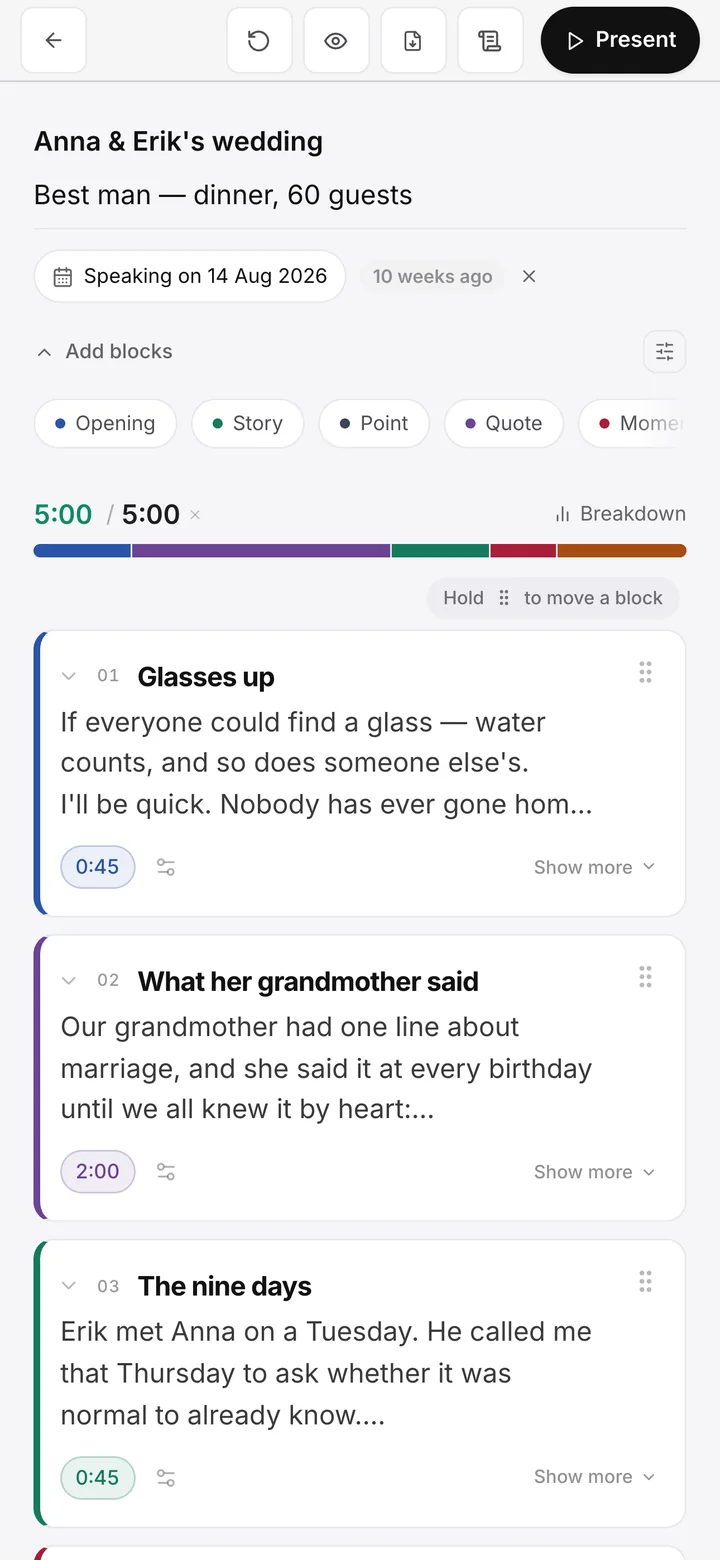
Every section gets a time, and the total tells you whether you will fit your slot. You write your lines directly inside each block, so the words and the shape never drift apart.
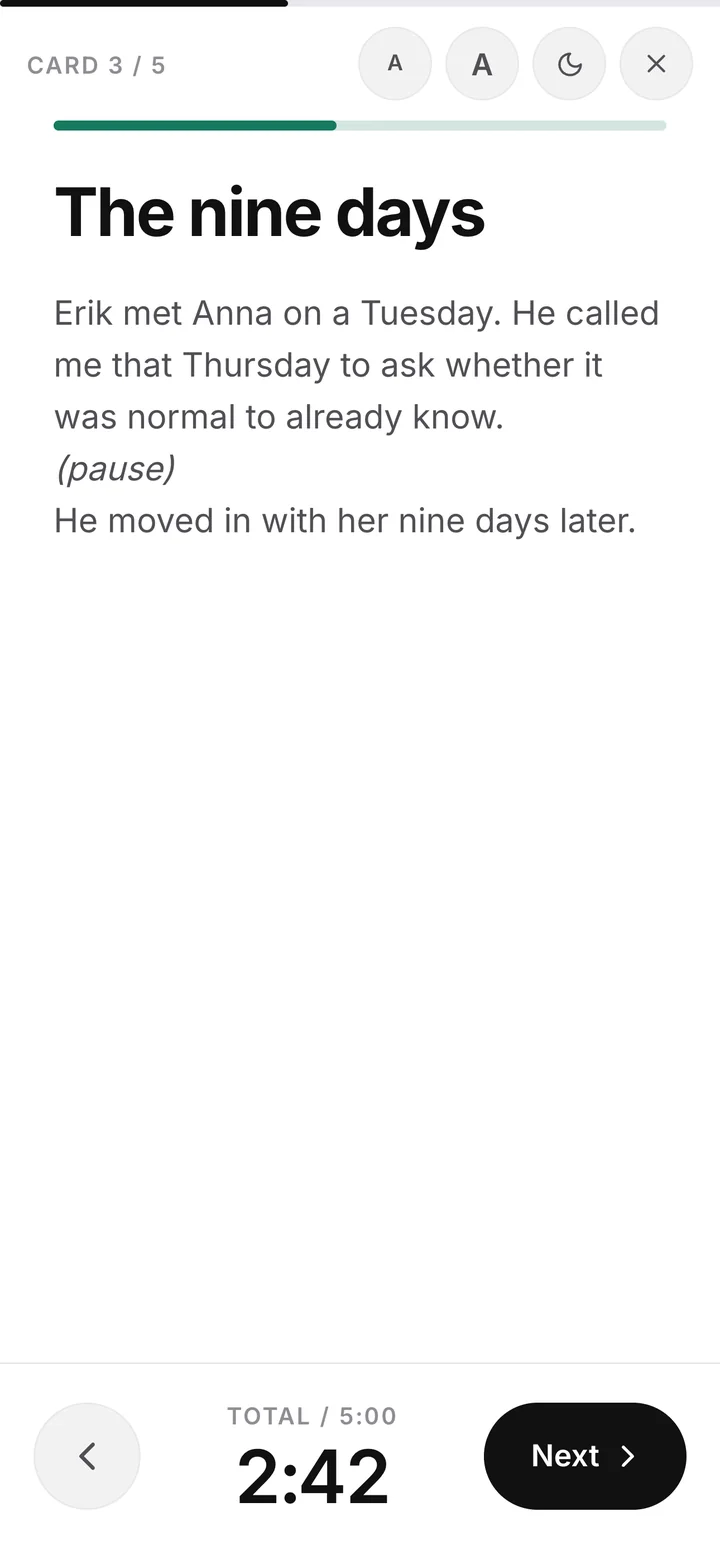
When it is time to deliver, the same outline becomes full-screen cue cards with a stage clock, or a teleprompter that follows the pace you planned.
Open this outline now Download on the App Store How long will it run? Use the speech time calculator → Thinking of letting AI write it? Read this first →
00:05Related
Other shapes for the same room.
The 90-second answer — one human line, your pitch early, then the proof and what you want to do here
The ten-minute task for a panel, then their questions — their problem, your plan, proof you have done it
Who you are, what you do, what you want — in 60 seconds
Introduce yourself to the club — 4 to 6 min
Answer on your feet in two minutes: point, reason, example, point
Warm, personal and ending with the toast — 3–5 min
 SpeechDraft
Open this outline in SpeechDraft.
The introduce yourself template, one of 64 in the app. Writing is free and never limited.
Free to start. Pro is $9.99, once.