A sermon outline template you can fill in
An outline is the sermon before the sentences: the order of the parts and what each one is for. This template has seven parts and one main point. Fill in a line for each, and you will know whether the sermon holds together before you write a paragraph.
Most sermons that wander had no outline, or had one with too many points. Give each part a length as well as a line. Twenty-five minutes fills up faster than it looks on paper.
00:01The structure
7 sections, in this order.
-
01
Opening
Where has the week left the people in front of you?
Opening: one line naming the scene or question you will start with. About three minutes.
-
02
Scripture
Which passage are you reading, and where do you slow down?
Scripture: the reference, and the single verse you will return to. About two minutes to read.
-
03
Point
What did it mean to the people who first heard it?
Then: one line on what the passage meant to its first hearers. Five minutes, and no more than one piece of background.
-
04
Story
What does it look like on an ordinary Tuesday?
Story: the name of the one story that shows it today. Four minutes. Write the last line of the story in full.
-
05
Point
What does it ask of this room?
Now: the main point as a sentence the room could repeat. Five minutes. This is the line the whole outline hangs on.
-
06
Closing
What is the one thing to carry into the week?
Closing: the one thing to carry into the week, said twice. Three minutes.
-
07
Prayer
What do you pray over them before they leave?
Prayer: three or four sentences in the words of the sermon. One minute.
00:02The rules
The rules of the room.
Structure carries the speech; these keep it out of trouble.
- One line per part first. Write the full text only when the seven lines read well in a row.
- One main point. Put it at the top of the page and check each part against it.
- Give every part a number of minutes and add them up before you write.
- If a part does not serve the main point, move it to another Sunday.
- Keep the finished outline to one page. It becomes your notes.
00:03Questions
Asked before every sermon outline template.
- What is a good sermon outline?
- Opening, passage, what it meant then, a story from now, what it asks, one thing to carry, prayer. Seven parts with one main point running through them.
- What is a three-point sermon outline?
- An introduction, three points drawn from the passage, and a conclusion. It is a common form. Many preachers now prefer one main point with the passage explained and applied, because one sentence is easier to remember.
- How long should each part of a sermon be?
- For twenty-five minutes: about three for the opening, two for the reading, five on the background, four on the story, five on what it asks, three to close and one to pray. Adjust to your own slot.
- Can I preach from the outline?
- Yes, once you have written the sermon out in full at least once. Put one part on each card with its first line and its key sentence.
00:04In the app
From outline to on time.
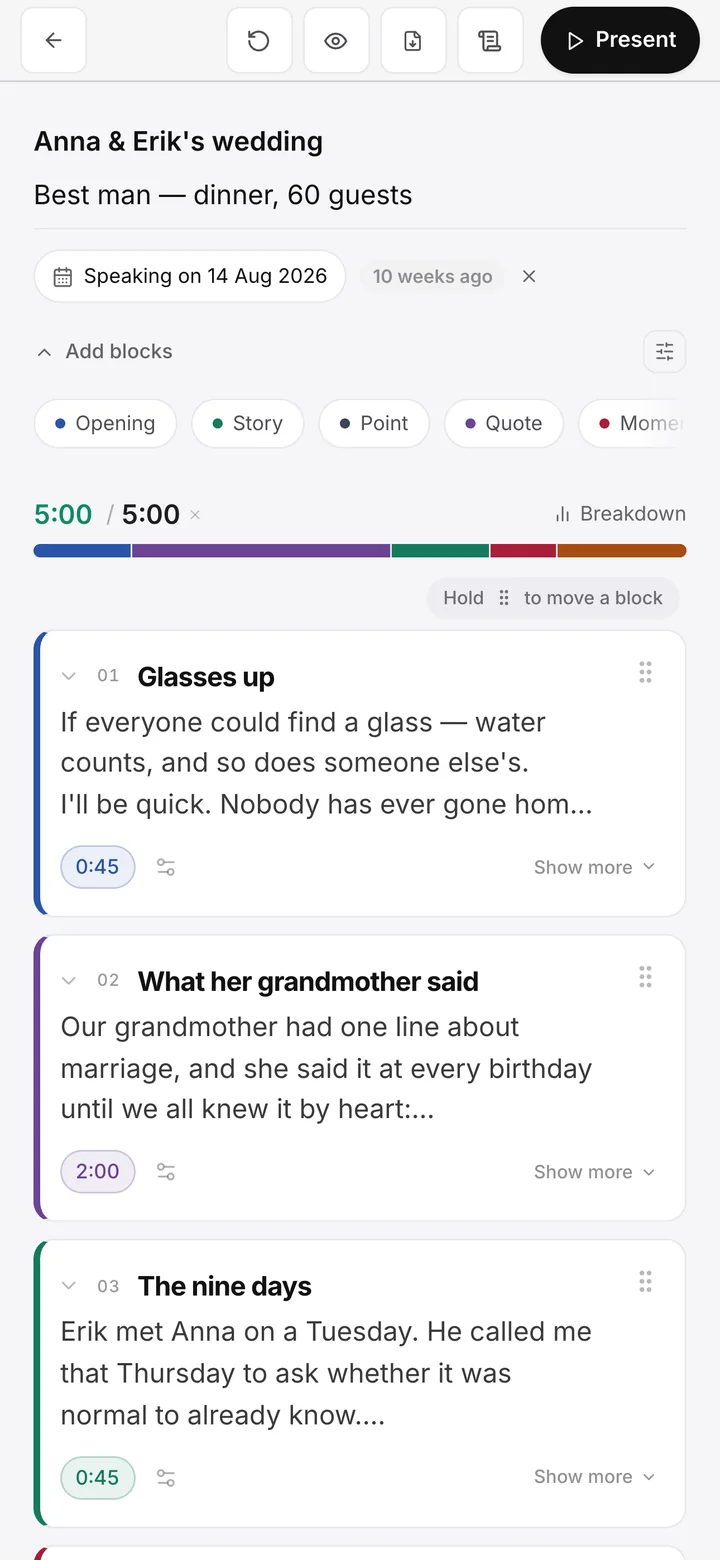
Every section gets a time, and the total tells you whether you will fit your slot. You write your lines directly inside each block, so the words and the shape never drift apart.
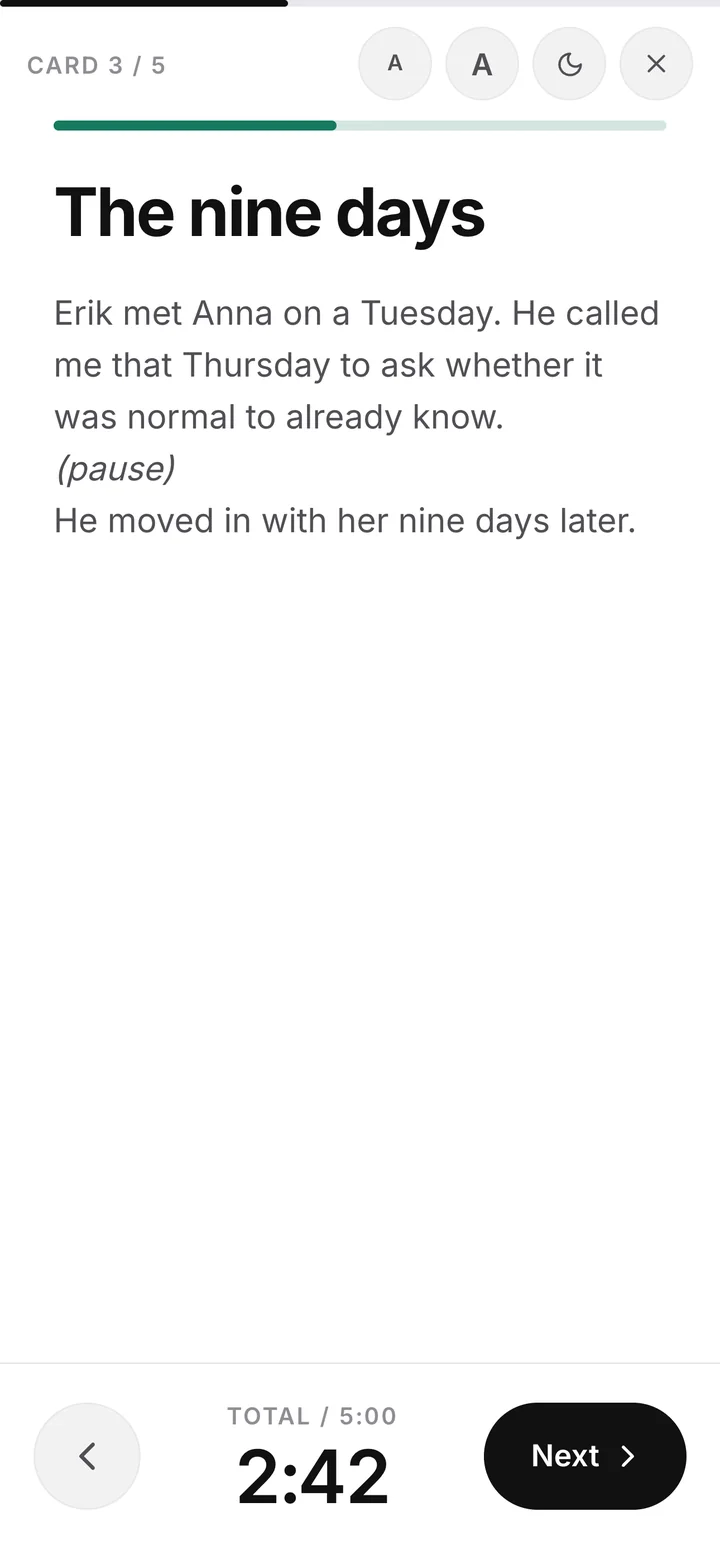
When it is time to deliver, the same outline becomes full-screen cue cards with a stage clock, or a teleprompter that follows the pace you planned.
Open this outline now Download on the App Store How long will it run? Use the speech time calculator → Thinking of letting AI write it? Read this first →
00:05Related
Other shapes for the same room.
A passage, a teaching and a call to live it out — 20–25 min
One story, one passage, one point they still have on Monday — 12 min
A sermon for teenagers: one story, one passage, one point
Your story in three parts — before, the turn, and since — 4 min
A short testimony to share on the day you are baptized
One verse, one thought, one question — for a team, a class or a meeting — 5 min
 SpeechDraft
Open this outline in SpeechDraft.
The sermon outline template uses the sermon outline, one of 64 in the app. Writing is free and never limited.
Free to start. Pro is $9.99, once.