How to write a prayer to say aloud
Praying aloud for a room is different from praying alone. People need to follow you and be able to say amen to it. Four short parts are enough: begin, give thanks, ask, and end.
Two minutes is the upper limit for most occasions, and one is often better. That is 130 to 250 words. It is fine to write it out and read it.
00:01The structure
4 sections, in this order.
-
01
Opening
How do you begin, in words this room would use?
Begin the way this room would. Use the words your church or family uses, and one line about why you are gathered. People settle when the first sentence sounds familiar.
-
02
Thank you
What is this room thankful for today, by name?
Give thanks for particular things: this meal, these people, the year that has passed, someone by name. Two or three, and not a list of everything.
-
03
Prayer
What are you asking for, and for whom?
Ask for what the occasion needs. Wisdom for a meeting, safety for a journey, comfort for a family. Say who it is for. One or two requests are easier to pray along with than ten.
-
04
Closing
How do you end, so everyone knows to say amen?
End clearly. Use the closing words people expect, so that everybody knows when to say amen.
00:02The rules
The rules of the room.
Structure carries the speech; these keep it out of trouble.
- One to two minutes. People are often standing with their eyes closed.
- Say “we” and not “I”. You are praying on behalf of the room.
- Short sentences. Long ones lose people who cannot see the page.
- It is a prayer and not an announcement. Leave notices and thanks to the organisers for afterwards.
- If the room holds people of different faiths or none, ask the organiser what is expected before you write.
00:03Questions
Asked before every prayer.
- How long should a prayer be when you pray in public?
- One to two minutes for an opening or closing prayer, and under a minute for grace before a meal. That is about 130 to 250 words.
- Is it all right to read a prayer from notes?
- Yes. A prayer you have thought about is easier for others to follow. Print it large or put one part on each cue card.
- How do I start an opening prayer?
- With the form of address your church or community uses, and one line naming why people have gathered. Then move to thanks.
- What is the difference between an invocation and a benediction?
- An invocation opens an event and asks for blessing on what is about to happen. A benediction closes it and sends people out. The same four parts work for both. Only the request changes.
00:04In the app
From outline to on time.
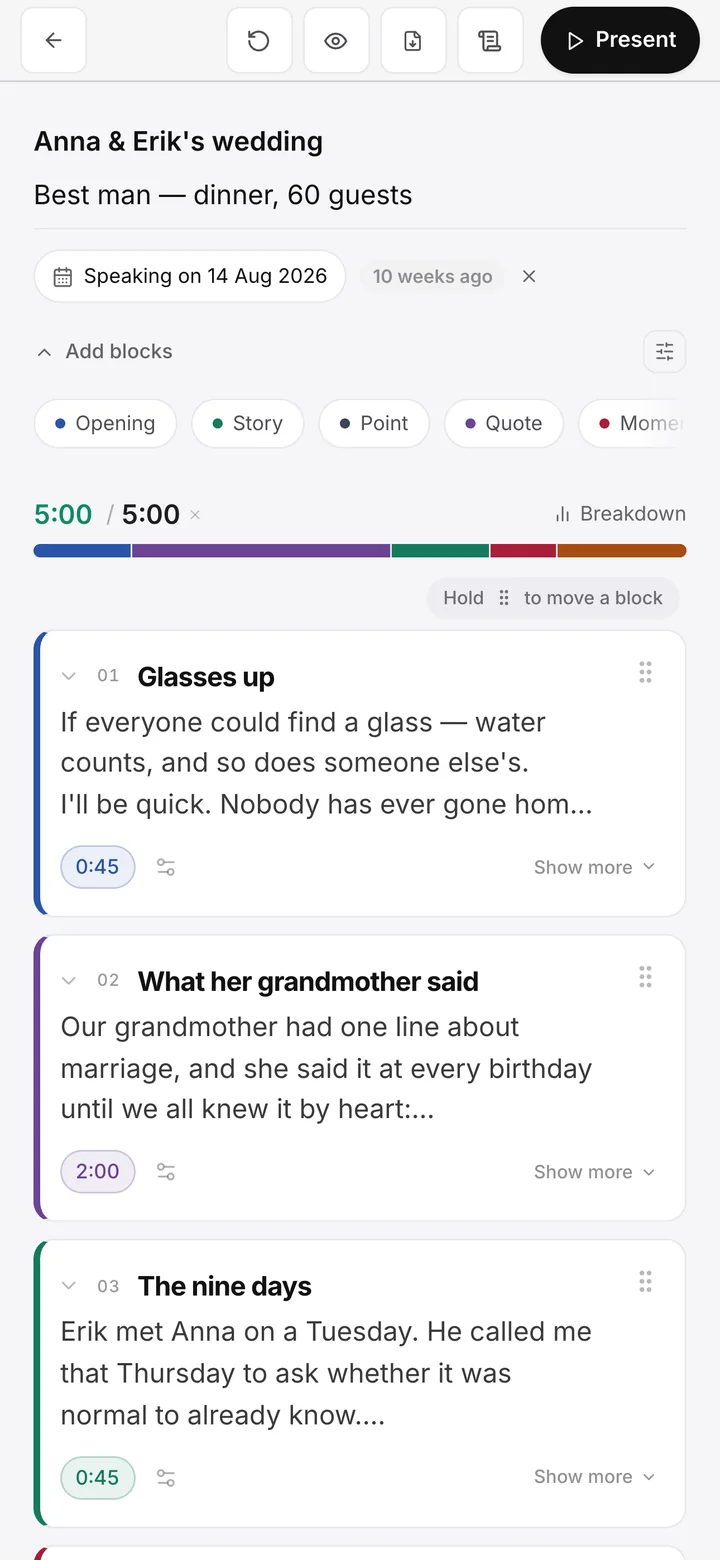
Every section gets a time, and the total tells you whether you will fit your slot. You write your lines directly inside each block, so the words and the shape never drift apart.
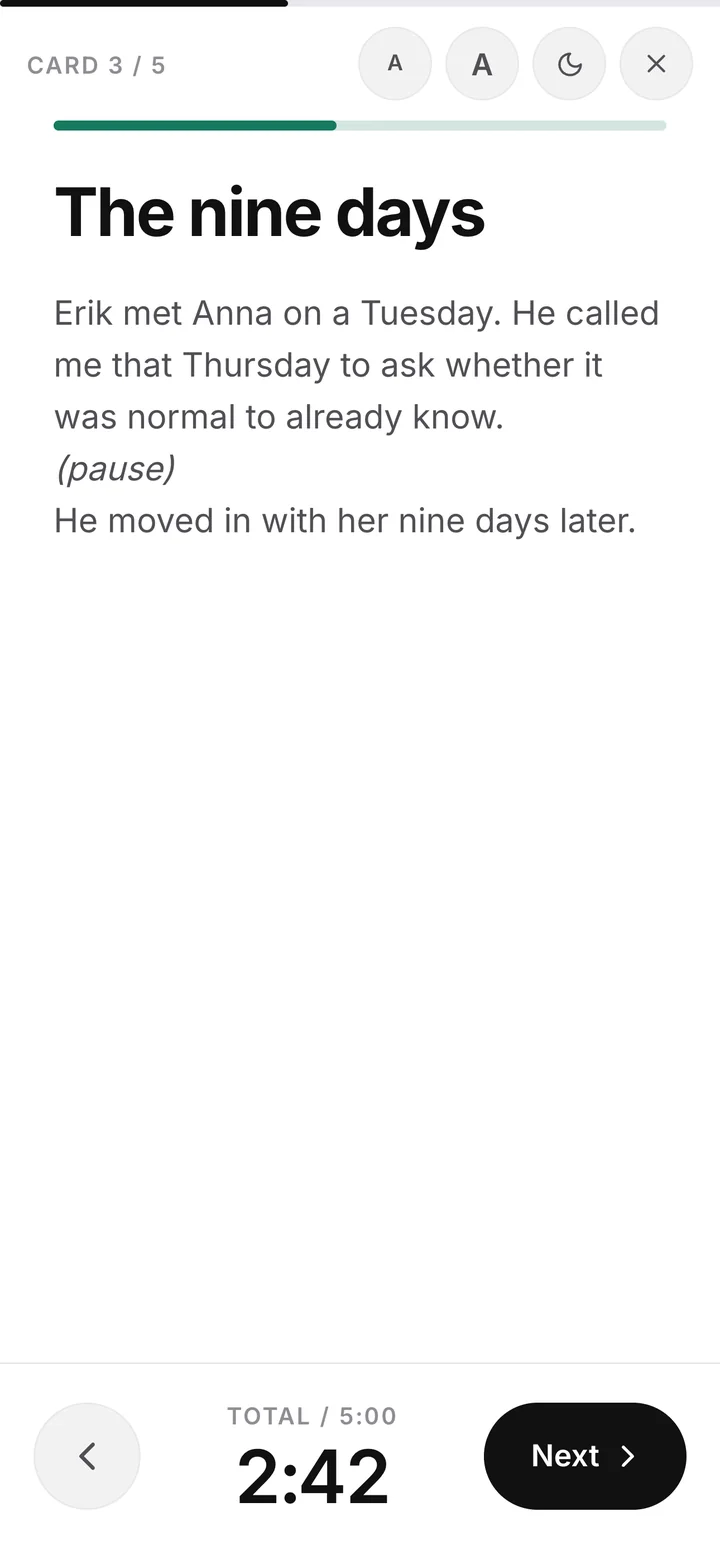
When it is time to deliver, the same outline becomes full-screen cue cards with a stage clock, or a teleprompter that follows the pace you planned.
Open this outline now Download on the App Store How long will it run? Use the speech time calculator → Thinking of letting AI write it? Read this first →
00:05Related
Other shapes for the same room.
A table prayer in your own words — thanks, a blessing, amen — under a minute
For the one asked to say it at the table — the year, the people, the empty chair — 2 min
A short prayer to open a meeting, a service or an event
One verse, one thought, one question — for a team, a class or a meeting — 5 min
Dinners, anniversaries, good news — one story and a raised glass, 1 min
Warm, personal and ending with the toast — 3–5 min
 SpeechDraft
Open this outline in SpeechDraft.
The prayer template, one of 64 in the app. Writing is free and never limited.
Free to start. Pro is $9.99, once.